 Lead · Strategy, web, content and a custom platform · 2025 to 2026
From a book website to a live decision game.
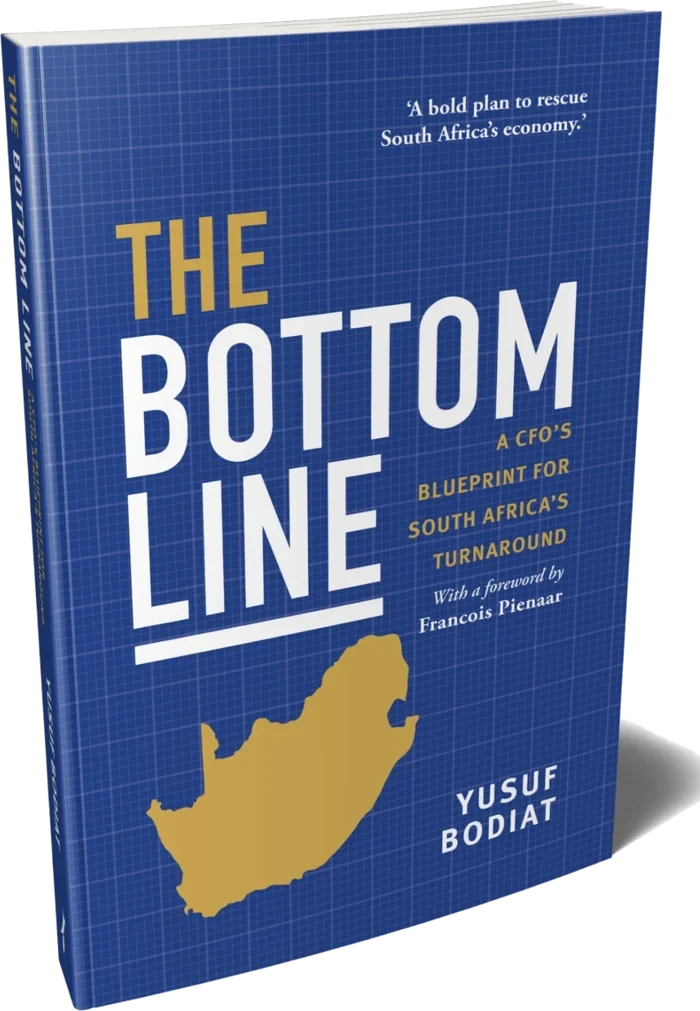
Yusuf Bodiat is a CA(SA), a senior finance, risk and governance executive, the founder of Pragmatic Thinking and the author of The Bottom Line. It began as a website for his book, and grew into a connected authority ecosystem, and then into The Game: a real-time executive decision challenge for HR Indaba and Finance Indaba 2026.
More than a book. A body of thinking.
Yusuf’s work reaches well beyond one book, and the website needed to show all of it. So the book became the front door to everything else he does. Before designing a page, we mapped Yusuf’s world into one system with four pillars, all leading back to the website.
The book sells the thinking. The content demonstrates the thinking. The events put people inside the thinking. The advisory work puts the thinking to work.
A book sold before it existed.
A personal authority platform with consulting, speaking and insights carrying the same weight as the book. A three-phase book journey on WooCommerce (register interest, then pre-order, then order) so demand and an email list built up months before stock landed.
Payments through PayFast, launched as a standard account so sales could start on time. A newsletter, The Perspective, on Kit. Calendly for booked conversations. And a hand-picked video gallery that needs no access to Yusuf’s YouTube account.
If South Africa were your company, what would you fix first?
Yusuf was invited to speak at HR Indaba and Finance Indaba 2026, with a stand at both. We wanted his stand to be the one delegates talk about afterwards. So we built The Game: every delegate takes the chair of South Africa’s CFO.
Each question is a real scenario with sensible, competing options. Answers score across the book’s five levers, and in about two minutes each delegate gets one of six leadership archetypes, with their strongest instinct and a likely blind spot. Try an example question.
An unexpected windfall lands. What do you do with it?
No right answers. Only revealing priorities.A stand that is an experience.
A live screen on the stand shows the collective mind of the room taking shape: fifteen configurable data points as headline numbers, bars, donuts, waffles, bubbles or heatmaps. Aggregates only. No names, no emails, no individual answers, ever. Counters stay hidden until there are enough responses to mean something.
Behind it, a private dashboard tracks every participant from played to newsletter, with contact details masked by default.
Nine problems, solved before the doors open.
It started as a form, a spreadsheet and an email tool. That proved the idea. As the brief grew, it graduated into a custom platform, built with exactly what the no-code version taught us.
A boardroom, not a survey
No “how important is cash flow?” questions. Real scenarios with defensible trade-offs, so people argue about their answers afterwards.
A fair scoring model
All 3,125 answer paths were simulated before the scoring was locked, so results spread across all six archetypes, with tie-break rules so every path lands on one.
Data without the queue walking away
Value first, details second. Delegates play and see their archetype before choosing to get the full result.
Two events, one platform
Questions, branding and QR codes are configuration, not code. One platform, two experiences, ready for any future room.
WhatsApp at conference scale
A Meta-approved message template, delivery tracking on every message, a reliable send queue, and a dry-run mode until go-live. We even tracked down and verified the business account behind the number.
Safe in a public hall
A full security and correctness review before launch, rate limiting sized for venue Wi-Fi, safety checks that fail closed, and no public sign-up at all.
POPIA and trust
Participation and marketing consent are never bundled. Delegates choose separately what they want to hear about.
The empty-screen problem
First thing in the morning, the screen leads with the challenge itself, and the live numbers take over as the room fills up.
Venue reality
A light mobile experience, a short typed URL as a backup to the QR code, a hotspot plan, and tested failure scenarios.